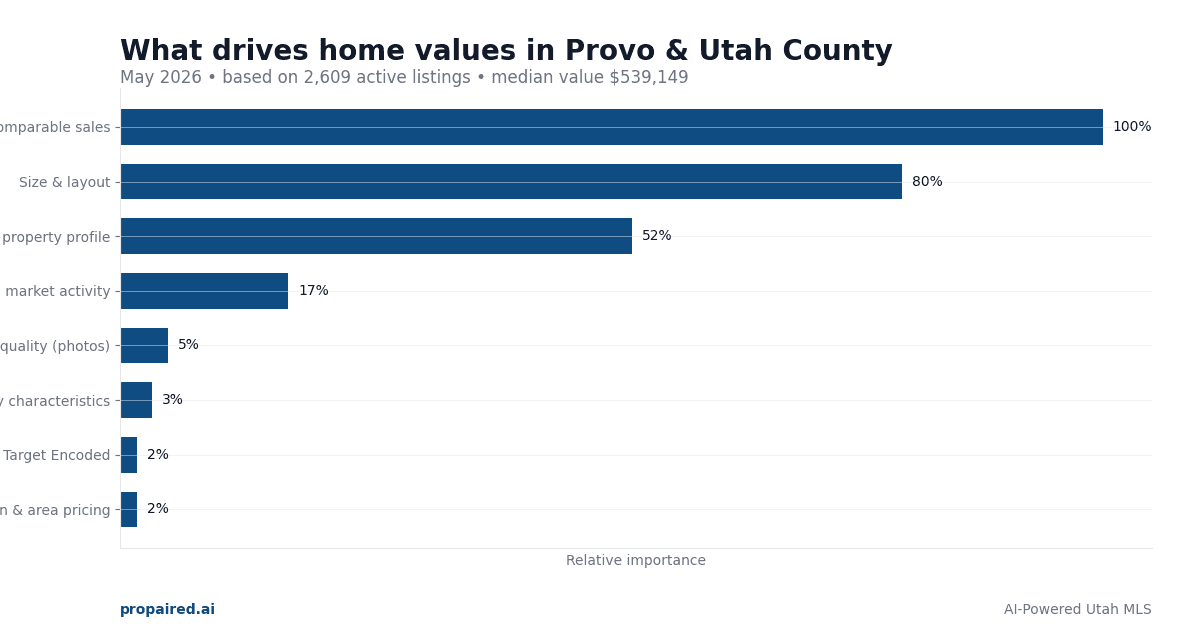
Home Values in Provo & Utah County Utah: 2026 Market Analysis & Seller Guide
Understanding Home Values in Provo & Utah County: What Drives Prices in 2026
Property fundamentals dominate value in this market — there's not much room for sellers to lift price through cosmetic improvements alone. With a median home value of $539,149 across Provo and Utah County, and active listings averaging 2,777 square feet, this remains one of Utah's most competitive markets. AOL reported in February that Provo housing costs may see some affordability improvements in 2026, though the city continues to rank among the top five most expensive in the U.S. for homebuying. Understanding how our automated valuation system weighs different factors can help sellers make strategic decisions about where to invest their time and money.
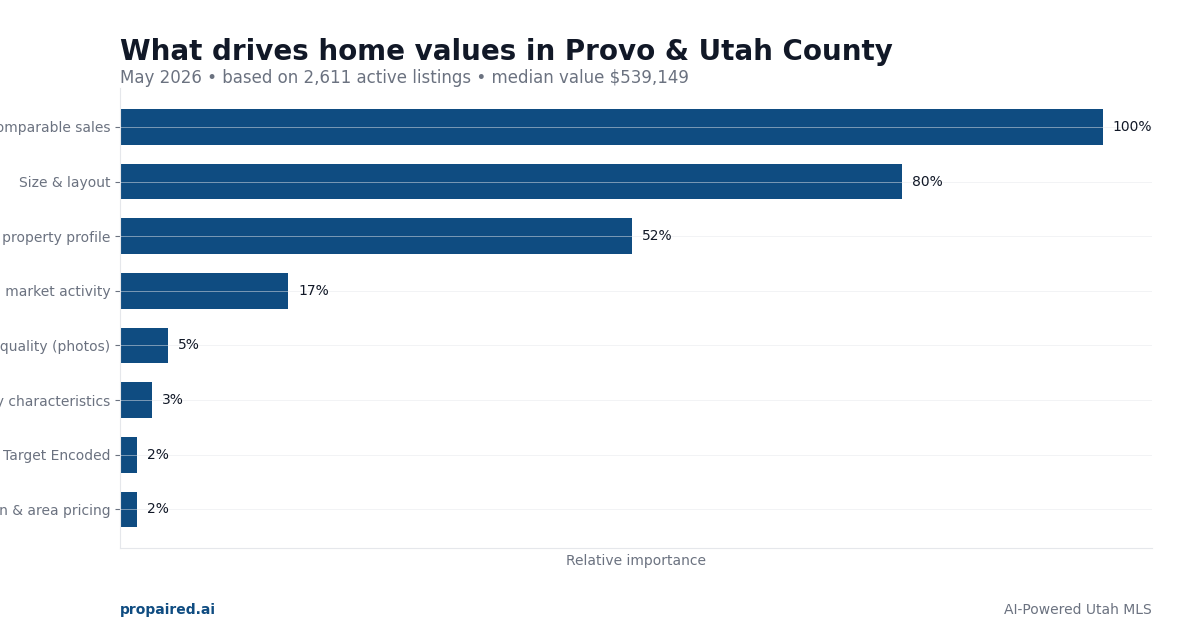
Top themes our automated valuation considers when pricing homes in Provo & Utah County.
The Foundation: How Our Valuation Model Works
Our automated valuation system analyzes thousands of data points to determine home values in Provo and Utah County, with comparable sales carrying the heaviest influence at about 36% of the final valuation. The model examines everything from recent neighborhood transactions to property-specific characteristics, creating a comprehensive picture of what drives prices in this market.
The system processes data from 2,609 active listings across single-family homes, condos, townhouses, and twins, with median list prices currently at $569,990. This represents the reality of a market where demand continues to outpace supply, despite some cooling from peak pandemic levels.
What makes our approach unique is how it weighs multiple factors simultaneously. While size and layout considerations account for significant value drivers, the model also incorporates neighborhood market activity, location and area pricing, and even visual quality from listing photos to create accurate valuations.
The Big Five: Primary Value Drivers in Provo & Utah County
Five major themes consistently drive home values higher in this market, and understanding their relative importance can guide seller strategy.
Size and layout emerges as the strongest positive influence, which makes sense in a market where the median home spans 2,777 square feet. Buyers here expect space — both in total square footage and in how that space is configured. Open floor plans, functional room layouts, and adequate storage consistently add value.
Overall property profile ranks second, encompassing the complete package of what makes a home desirable. This includes architectural style, build quality, lot characteristics, and how well the property fits neighborhood expectations.
Comparable sales data provides the market reality check, ensuring valuations align with what similar homes have actually sold for recently. In a market as dynamic as Provo's, this real-time pricing feedback prevents both over and under-valuations.
Neighborhood market activity reflects the micro-market dynamics within Utah County. Some neighborhoods are seeing faster appreciation, higher turnover, or shifting buyer preferences — all factors that influence individual home values.
Location and area pricing captures the premium (or discount) associated with specific geographic areas, school districts, and proximity to amenities like BYU, tech corridors, and outdoor recreation access.
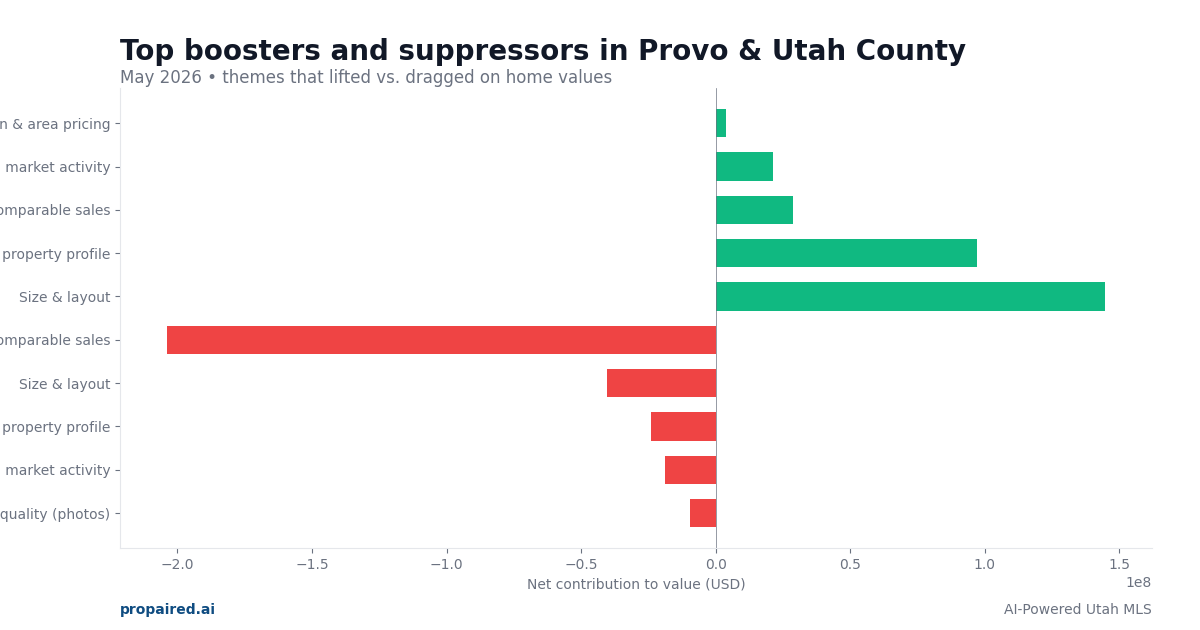
Where Provo & Utah County sellers can lift their value vs where the market is dragging on it.
Market Pressures: What's Working Against Sellers
The same factors that drive values up can also suppress them when properties fall short of market expectations. Comparable sales data cuts both ways — while strong neighborhood sales lift all boats, properties that can't compete with recent transactions face downward pressure.
Size and layout limitations hit particularly hard in Utah County, where families expect generous living spaces. Homes with cramped layouts, insufficient bedrooms, or awkward floor plans struggle to command premium pricing, regardless of other positive attributes.
Visual quality from listing photos represents a controllable factor that many sellers overlook. Poor photography, cluttered rooms, or outdated presentation can significantly impact perceived value, even when the underlying property is solid.
Deseret News recently highlighted rising costs and affordability challenges facing Utah households, creating a more price-sensitive buyer pool. This means properties must truly justify their asking prices through demonstrable value rather than relying on market momentum alone.
Strategic Improvements: Where Sellers Can Make an Impact
While property fundamentals dominate pricing, strategic improvements can help homes achieve their full market potential. Our analytics team has identified specific actions that consistently deliver results for Provo and Utah County sellers.
Kitchen and bathroom refreshes top the list for good reason. These spaces receive intense buyer scrutiny, and relatively modest investments in hardware, lighting, counters, and fixtures often yield strong returns. The key is improving presentation rather than complete renovations — buyers want to see quality and care, not necessarily the latest trends.
Professional photography and staging address the visual quality factor directly. In a market where buyers often make initial decisions based on online listings, compelling photos can mean the difference between showings and being overlooked. This is especially critical given that visual quality currently suppresses more home values than it enhances.
Curb appeal and exterior improvements create crucial first impressions. Landscaping, paint touch-ups, and exterior cleanup signal to buyers that the property has been well-maintained — a key concern in Utah's climate with its temperature extremes and seasonal challenges.
The average achievable seller uplift when top suggestions are addressed is $85 — not massive, but meaningful in a competitive market where every advantage counts.
Market Context: Provo's Position in 2026
Provo continues to face unique market dynamics that set it apart from other Utah metros. A recent Stacker analysis of Utah's fastest-growing home price cities provides broader context for local trends, while the ongoing Provo Towne Centre redevelopment proposal signals continued investment in the area's future.
The city's proximity to BYU, growing tech sector, and outdoor recreation access maintains strong demand fundamentals. However, the gap between median incomes and housing costs creates ongoing affordability pressures that influence buyer behavior and price sensitivity.
Current market conditions favor neither buyers nor sellers exclusively — it's a balanced market where success depends on realistic pricing, strategic presentation, and understanding what today's buyers prioritize. Properties that align with market expectations move efficiently, while those that don't can linger regardless of their underlying quality.
For sellers, this environment rewards preparation and strategic thinking over hoping for market momentum to carry the day. Understanding how automated valuation systems like ours weigh different factors provides a roadmap for maximizing your home's appeal to both algorithms and human buyers.
Home values in Provo and Utah County reflect a complex interplay of property characteristics, market dynamics, and buyer expectations. While size and layout, overall property profile, and comparable sales data drive the majority of pricing decisions, sellers can influence outcomes through strategic improvements and professional presentation. The key is focusing on changes that address the factors our valuation model — and buyers — care about most. In a market where property fundamentals matter more than cosmetic fixes, understanding these dynamics gives sellers the best chance to achieve their goals while serving buyers who are increasingly selective about where they invest their housing dollars.

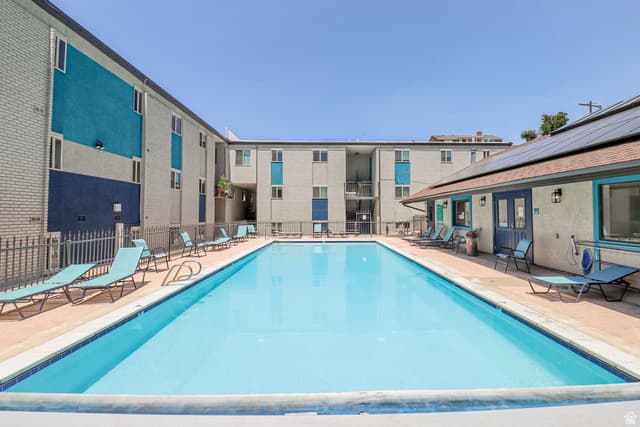
What's selling in Provo & Utah County right now
Related news
Comments
Sign in to leave a comment.
