Home Values in Cedar City Utah 2026: What Drives Prices & Market Trends
Understanding Home Values in Cedar City Utah: 2026 Market Analysis
Cedar City's real estate market tells a story of property fundamentals dominating value — and frankly, there's not much room for sellers to lift prices through cosmetic improvements alone. With our automated valuation system tracking just 6 active listings and a median home value of $417,611, this market operates on different principles than Utah's larger metros. While recent mortgage rate increases have created headwinds statewide, Cedar City's unique position as both a university town and growing industrial hub means understanding what truly drives home values here requires looking beyond surface-level improvements.
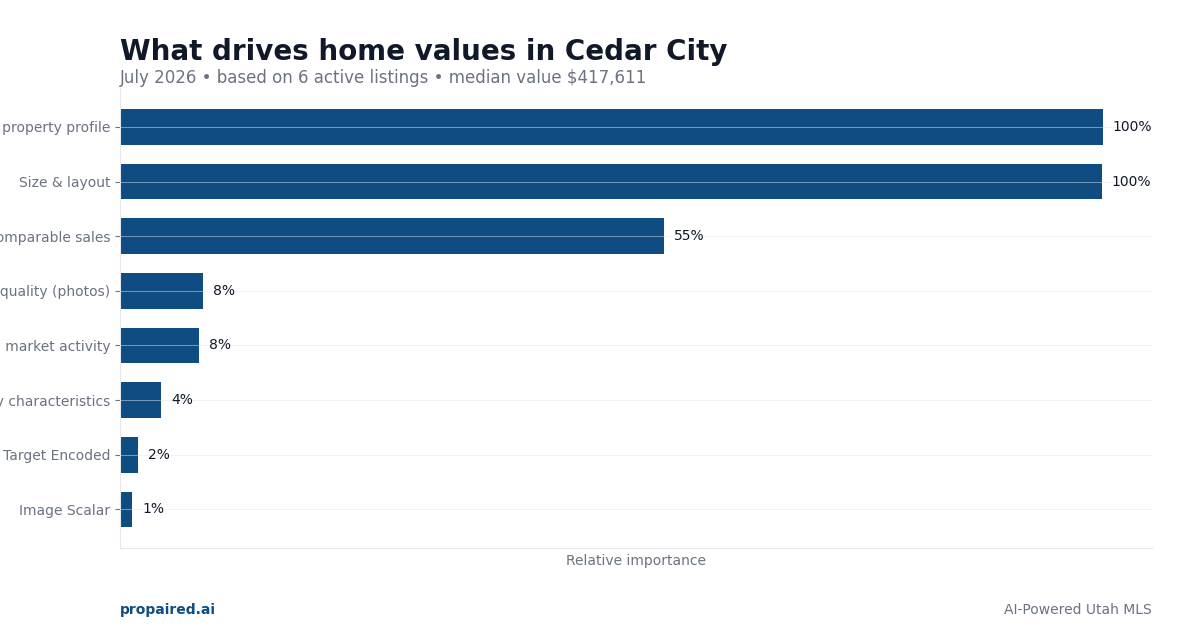
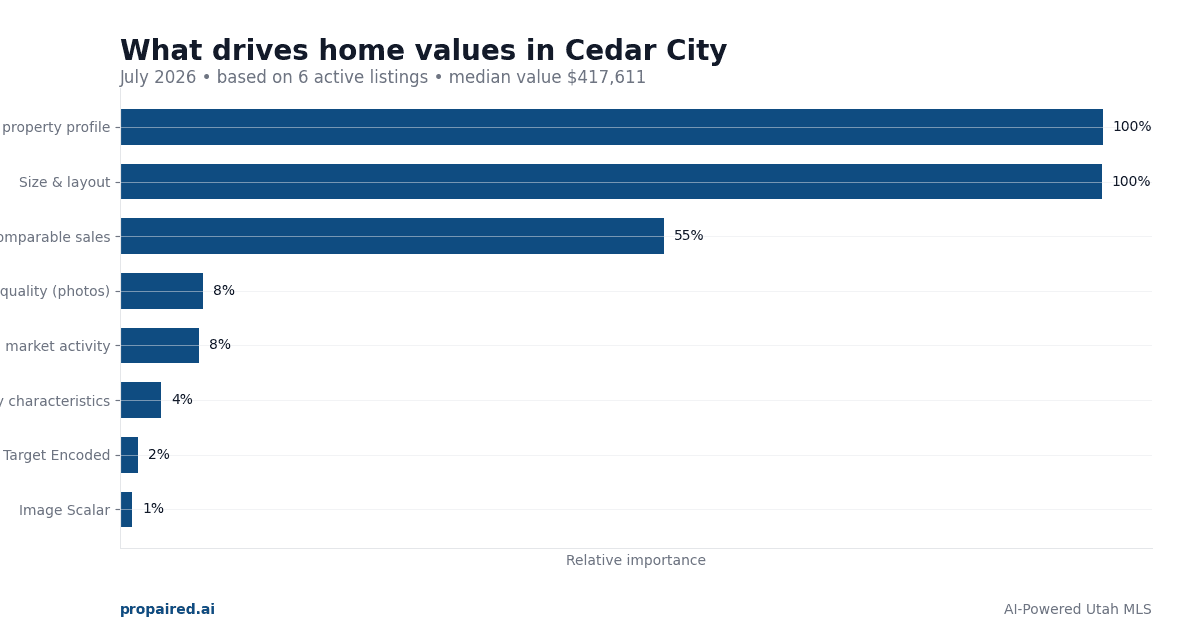
Top themes our automated valuation considers when pricing homes in Cedar City.
Current Market Snapshot: Cedar City by the Numbers
Cedar City's housing market operates in a distinctly different environment than Salt Lake City or Provo. With only 6 active single-family, condo, townhouse, and twin home listings currently on the market, we're looking at an extremely tight inventory situation.
Our market-trend model shows the median home value at $417,611, with properties ranging from $296,652 at the 25th percentile to $607,839 at the 75th percentile. The median list price sits at $429,900, suggesting sellers are pricing slightly above our automated valuation estimates — a common pattern in low-inventory markets.
The typical Cedar City home offers 1,734 square feet of living space, and here's where it gets interesting: our comparable-sales engine accounts for about 21% of valuation influence on average, which is relatively low compared to larger Utah markets. This tells us that property-specific characteristics matter more here than broader neighborhood comps.
What Actually Drives Home Values in Cedar City
Our automated valuation system has identified some fascinating patterns in how Cedar City home values are determined. Unlike markets where cosmetic improvements can significantly boost prices, property fundamentals reign supreme here.
Size and layout emerges as the most complex factor, showing both the strongest positive influence (when optimized) and significant negative impact (when poorly configured). This makes sense in a market where buyers have limited options — they're scrutinizing every square foot and how it's utilized.
Comparable sales data carries substantial weight, but with interesting nuances. While recent sales provide important benchmarks, the limited inventory means each transaction has outsized influence on neighborhood valuations. Our image-based condition scoring reveals that visual quality — how a property presents in photos — creates measurable value differences, though not to the extent we see in competitive markets.
Perhaps most telling is how overall property profile factors into valuations. In Cedar City, buyers aren't just choosing between similar homes — they're often deciding whether to buy locally or look elsewhere entirely.
The Role of Market Context
Recent economic developments add layers to Cedar City's valuation story. Deseret News reported that mortgage rates have risen sharply, reaching 6.51% for 30-year fixed mortgages, with some weeks seeing rates climb to levels not seen since August 2025. For a market like Cedar City, where the median home approaches $430,000, these rate increases translate to roughly $100 additional monthly payment costs.
However, local economic expansion provides a counterbalance. Trigg Minerals' planned $287 million expansion in Cedar City will create 400 new jobs, potentially strengthening housing demand despite broader rate pressures. This type of industrial investment often creates sustained upward pressure on local home values.
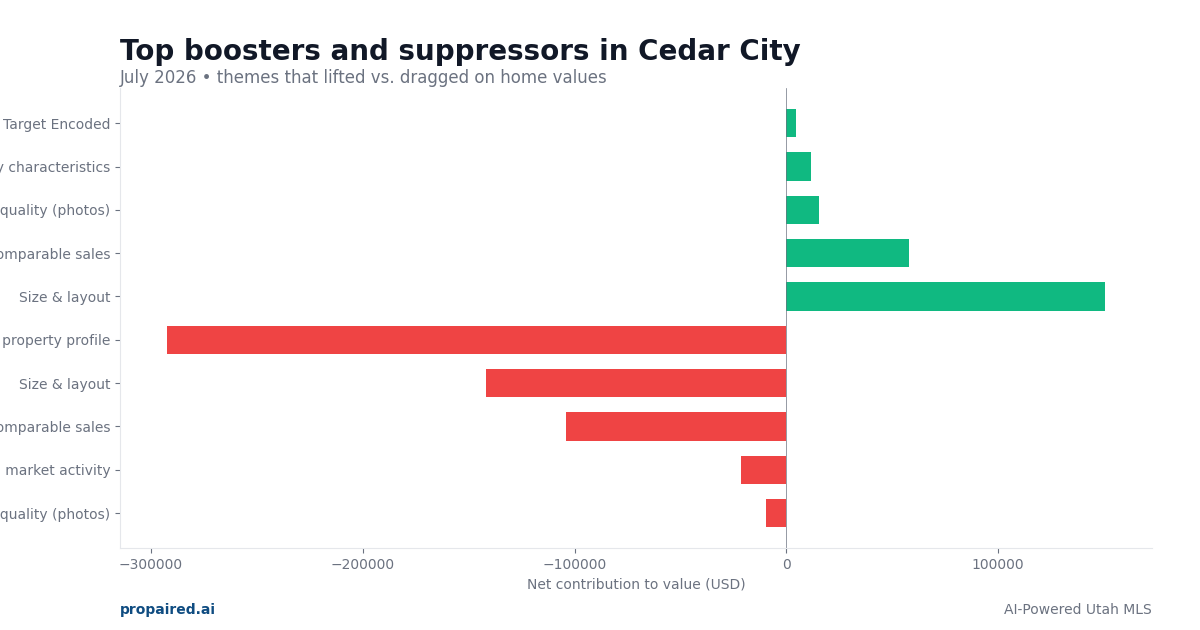
Where Cedar City sellers can lift their value vs where the market is dragging on it.
Market Conditions and Buyer Behavior
Cedar City operates as a balanced market with unique characteristics. The extremely low inventory creates seller advantages, but the limited buyer pool means properties must be priced and presented strategically.
Our valuation model shows that neighborhood market activity can actually suppress values in some cases — a counterintuitive finding that reflects Cedar City's specific dynamics. When too many properties hit the market simultaneously in this small metro, it can create temporary oversupply that pressures prices downward.
Target encoded factors — essentially how similar properties have performed historically — show positive influence on current valuations. This suggests that Cedar City's market has developed consistent pricing patterns that buyers and sellers can rely on, despite the limited transaction volume.
The image-based scoring system reveals something important about buyer behavior here: presentation quality matters, but not as dramatically as in competitive markets. Buyers seem more focused on fundamental property characteristics than staging and photography, though quality visuals still provide measurable advantages.
Infrastructure and Amenity Impacts
Cedar City's recent approval of a $1.3 million contract for Fiddlers Park development signals ongoing municipal investment in quality-of-life amenities. These infrastructure improvements typically create gradual upward pressure on property values, particularly for homes within proximity to new recreational facilities and pedestrian infrastructure.
Our automated valuation system accounts for these neighborhood enhancements through location-based factors, though the full impact often takes 12-18 months to materialize in comparable sales data.
Understanding Valuation Methodology
Propaired's automated valuation approach combines multiple data streams to create comprehensive property assessments. Our comparable-sales engine analyzes recent transactions, but in Cedar City's limited market, we weight this data carefully to avoid over-reliance on outlier sales.
Property characteristics receive heavy emphasis — things like lot size, home age, bedroom and bathroom counts, and architectural features. Our image-based condition scoring evaluates listing photos to assess maintenance levels, update quality, and overall presentation standards.
The market-trend model incorporates broader economic indicators, seasonal patterns, and local development activity. In Cedar City, this includes tracking Southern Utah University enrollment trends, tourism patterns, and industrial development like the Trigg Minerals expansion.
What makes Cedar City unique is how these factors interact. Size and layout optimization can create substantial value, but only when aligned with local buyer preferences. Visual quality improvements help, but fundamental property characteristics matter more than cosmetic enhancements.
The Reality of Limited Inventory
With only 6 active listings across all property types, Cedar City sellers face a different calculus than those in high-inventory markets. Our data shows average achievable seller uplift of $0 when top improvement suggestions are addressed — a stark reminder that in thin markets, pricing strategy often matters more than property improvements.
This doesn't mean improvements are worthless, but rather that they're unlikely to generate returns above proper market pricing. Sellers should focus on presenting their property's existing strengths rather than investing heavily in upgrades that may not translate to higher sale prices.
Cedar City's real estate market rewards understanding over optimization. With property fundamentals driving the majority of value and limited inventory creating unique dynamics, both buyers and sellers benefit from data-driven approaches rather than conventional wisdom from larger markets.
The combination of rising mortgage rates and local economic expansion creates an interesting tension that our automated valuation system continues to monitor. While rate increases challenge affordability, job creation from industrial investments like Trigg Minerals provides fundamental demand support.
For current and prospective homeowners, the key insight is that Cedar City values reflect property reality more than market perception. In a market this small, authentic property characteristics matter more than presentation tricks, and pricing accuracy trumps improvement investments. Understanding these dynamics — rather than fighting them — creates the best outcomes for everyone involved.



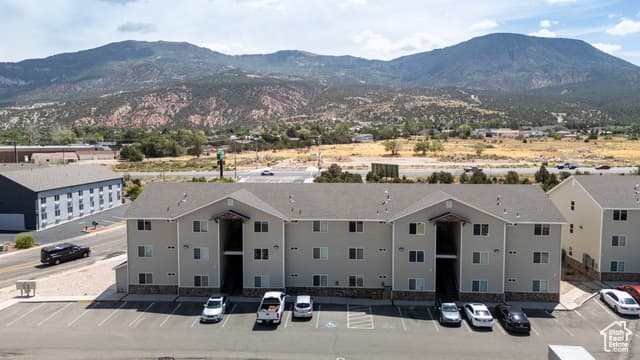
What's selling in Cedar City right now
Related news
Comments
Sign in to leave a comment.
