Home Values in Cedar City Utah 2026: What Drives Prices & Seller Tips
Home Values in Cedar City Utah: What Really Drives Prices in 2026
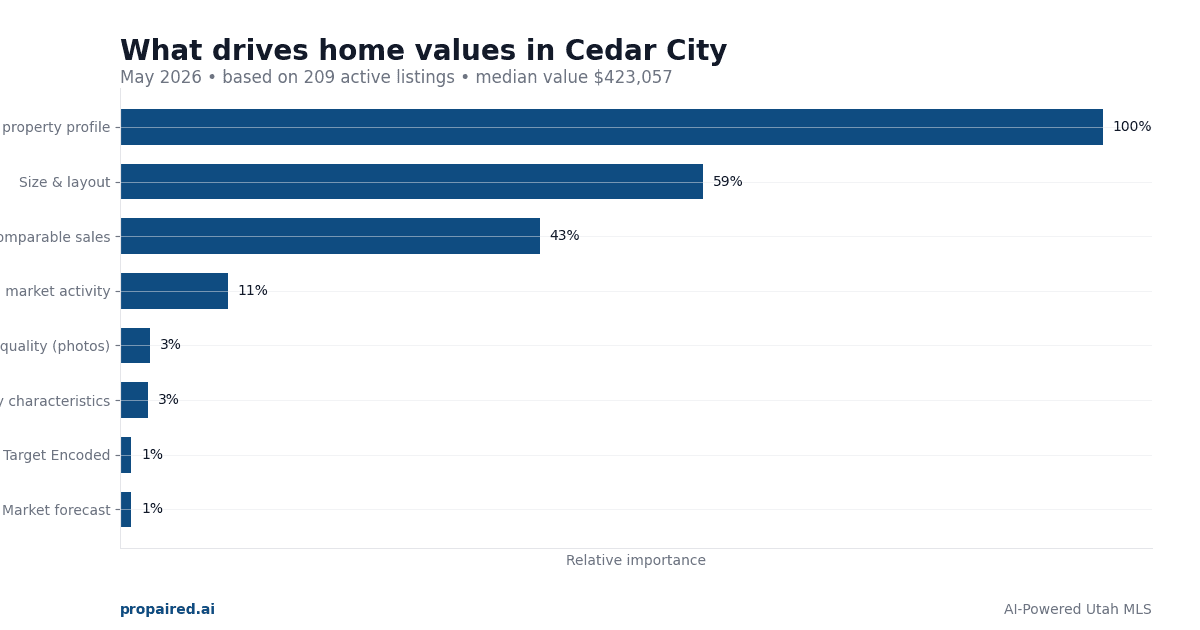
If you're wondering about home values in Cedar City Utah, here's the reality: property fundamentals dominate this market. With a median home value of $423,057 and active inventory sitting at 209 listings, Cedar City's housing market is driven primarily by core property characteristics rather than cosmetic improvements. While sellers can achieve an average uplift of around $180 when addressing key value drivers, there's limited room for dramatic price increases through surface-level enhancements alone. Our automated valuation system reveals that overall property profile and size & layout carry the heaviest weight in determining home values here, accounting for the lion's share of pricing decisions.
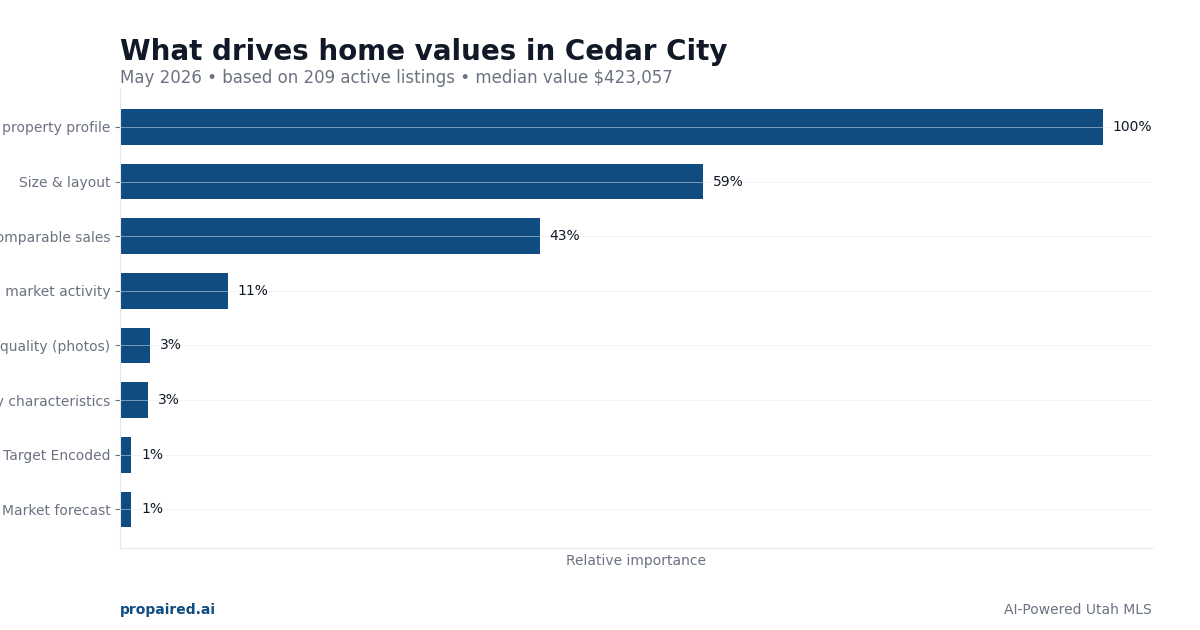
Top themes our automated valuation considers when pricing homes in Cedar City.
Understanding Cedar City's Current Market Dynamics
Cedar City's housing market reflects both opportunity and caution in 2026. With homes ranging from $348,599 at the 25th percentile to $539,149 at the 75th percentile, there's significant variation in property values across the area. The median living area of 1,836 square feet provides a baseline for comparison, while the median list price of $434,000 sits slightly above our automated valuation median.
Recent developments paint a mixed picture for the local economy. Cedar City celebrated a major hospital expansion, doubling emergency room capacity and adding a new molecular imaging center—a clear signal of economic growth and increased healthcare infrastructure. However, the closure of Genpak manufacturing plant resulted in 200 layoffs, creating uncertainty for some residents who relied on the facility for employment and retirement security.
The Cedar Valley Water Project received key environmental approval, enhancing the region's water infrastructure and boosting long-term attractiveness for homeowners. Meanwhile, a proposed AI data center faces resistance from residents concerned about environmental impact, though it could potentially bring new jobs to the area.
What Our Valuation Model Reveals About Cedar City Pricing
Our market-trend model analyzes thousands of data points to understand what truly drives home values Cedar City residents experience. The results show that comparable sales influence about 31% of valuations on average, while property-specific factors account for the majority of pricing decisions.
Overall property profile emerges as the dominant factor, with a total weight of over 20 million across our analysis of 209 listings. This encompasses everything from architectural style to overall condition and desirability. Size & layout follows closely behind with significant influence on pricing, though it can work both ways—some configurations boost values while others suppress them.
Neighborhood market activity plays a meaningful role, reflecting how local sales momentum and inventory levels impact individual property values. Interestingly, visual quality from photos shows up as primarily negative, suggesting many listings suffer from poor presentation that drags down perceived value.
Our image-based condition scoring reveals that properties with better visual presentation consistently outperform those with subpar photography or staging, even when the underlying property characteristics are similar.
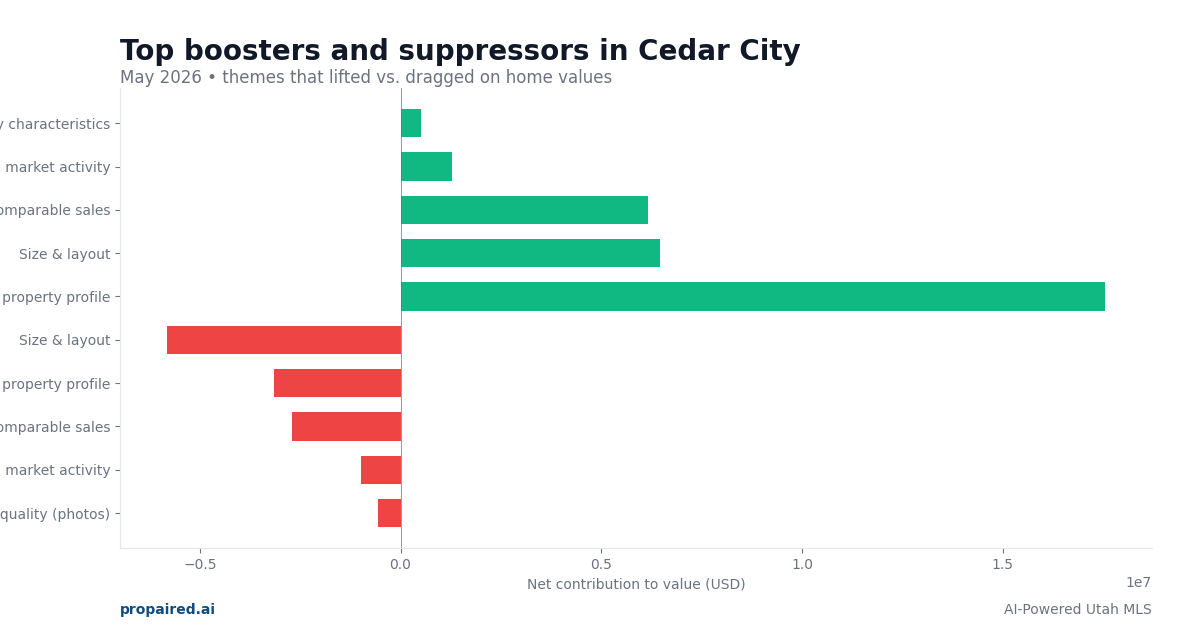
Where Cedar City sellers can lift their value vs where the market is dragging on it.
Key Factors That Boost Cedar City Home Values
The strongest drivers lifting Cedar City Utah home prices 2026 center around fundamental property attributes rather than superficial improvements. Overall property profile leads the pack, encompassing factors like architectural appeal, lot characteristics, and overall desirability within the local context.
Size & layout optimization proves crucial—homes with functional floor plans and appropriate square footage for their price range consistently outperform awkward or inefficient designs. This doesn't necessarily mean bigger is always better; rather, it's about matching size and configuration to market expectations.
Comparable sales momentum in your immediate area significantly impacts your home's valuation. Properties in neighborhoods with recent strong sales activity benefit from positive market perception and buyer confidence. Neighborhood market activity reinforces this trend, with areas showing consistent transaction volume and price stability commanding premium valuations.
Property characteristics that align with buyer preferences—such as updated systems, quality construction, and desirable features—provide measurable value increases. However, the impact varies significantly based on execution and market positioning.
Common Value Suppressors in Cedar City
Understanding what drags down home values Cedar City properties experience is equally important for sellers. Size & layout issues top the list of suppressors, particularly when homes feel cramped, have poor flow, or include wasted space that doesn't translate to livable area.
Overall property profile can work against you when homes lack character, sit on less desirable lots, or suffer from deferred maintenance that's visible to buyers. Comparable sales in your area can also suppress values if recent transactions involved distressed properties or homes that sold below market expectations.
Visual quality emerges as a significant suppressor across our analysis, with poor photography and presentation consistently dragging down perceived value. This represents one of the most addressable issues for sellers, as professional photography and staging can dramatically improve how properties are perceived online.
Neighborhood market activity can work against you in areas with high inventory, extended days on market, or recent price reductions. While you can't control broader market conditions, understanding these dynamics helps set realistic expectations.
Strategic Improvements That Actually Move the Needle
When it comes to maximizing your sell home Cedar City potential, focus on improvements that address the core value drivers our automated valuation identifies. Repairs, cleaning, and maintenance ($2,000–$12,000) should be your first priority—address deferred maintenance before any cosmetic updates.
Kitchen and bathroom refreshes ($300–$8,000 and $300–$4,000 respectively) offer strong returns when executed thoughtfully. Focus on hardware updates, improved lighting, and fresh photography rather than full renovations. Curb appeal improvements ($300–$3,000) through landscaping, cleanup, and exterior touch-ups create crucial first impressions.
Professional staging and photography ($1,500–$4,000) directly addresses the visual quality issues our model identifies as value suppressors. Interior presentation improvements ($500–$8,000) through cleaning, paint, and decluttering help properties photograph better and feel more spacious.
Don't overlook zero-cost opportunities: if your home has a pool, scenic views, or finished basement, ensure these features are properly showcased in your listing photos. These additions cost nothing but can significantly impact buyer perception and valuation.
Home values in Cedar City Utah reflect a market where property fundamentals matter more than flashy upgrades. With our automated valuation showing a median of $423,057 and average achievable seller uplift of $180, success comes from understanding what buyers actually value. Focus on core property characteristics, address maintenance issues, and invest in quality presentation. While economic uncertainties like the Genpak plant closure create headwinds, positive developments like hospital expansion and water infrastructure improvements support long-term market stability. The key is realistic expectations combined with strategic improvements that align with what our comparable-sales engine and market-trend model identify as true value drivers.
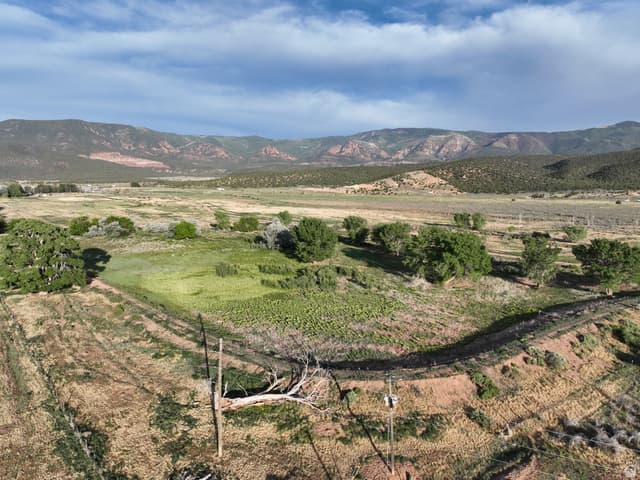
What's selling in Cedar City right now
Related news
Comments
Sign in to leave a comment.
