Home Values in Salt Lake City Utah 2026: What Drives Prices & Seller Strategy
Home Values in Salt Lake City Utah: What Really Drives Prices in 2026
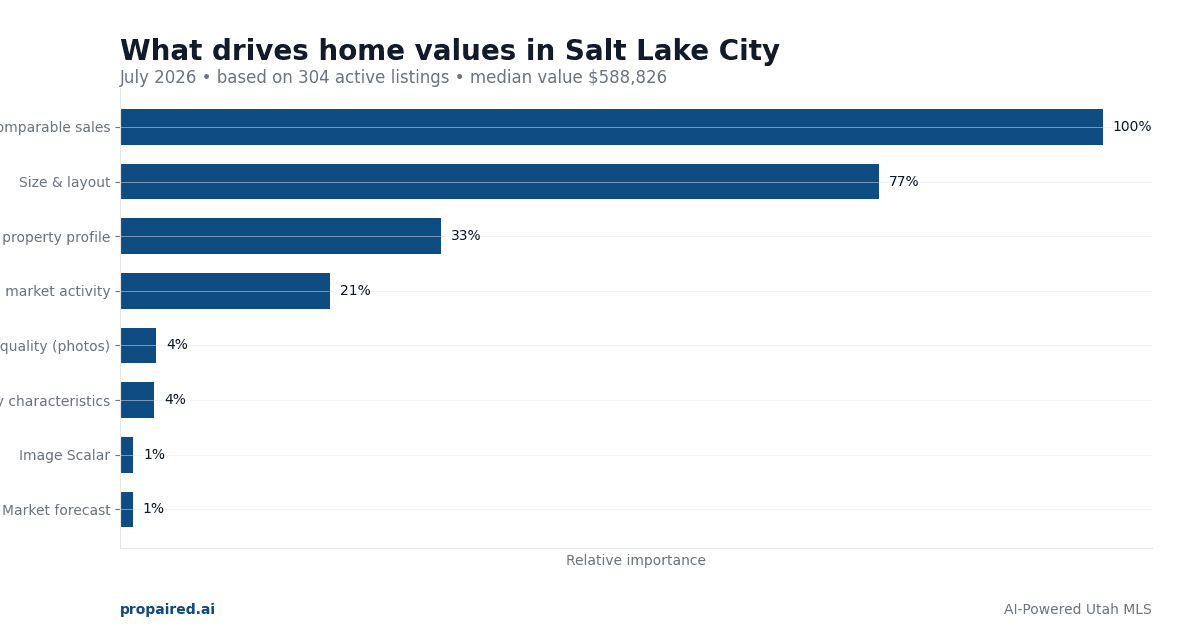
If you're wondering about home values in Salt Lake City Utah, here's the reality: property fundamentals dominate this market, and there's not much room for sellers to lift prices through cosmetic improvements alone. With our automated valuation system analyzing 304 active listings across the metro, the median home value sits at $588,826, while list prices average $629,999. The data tells a clear story—in Salt Lake City's competitive landscape, size & layout, comparable sales, and overall property profile are the heavyweight champions determining what your home is actually worth.
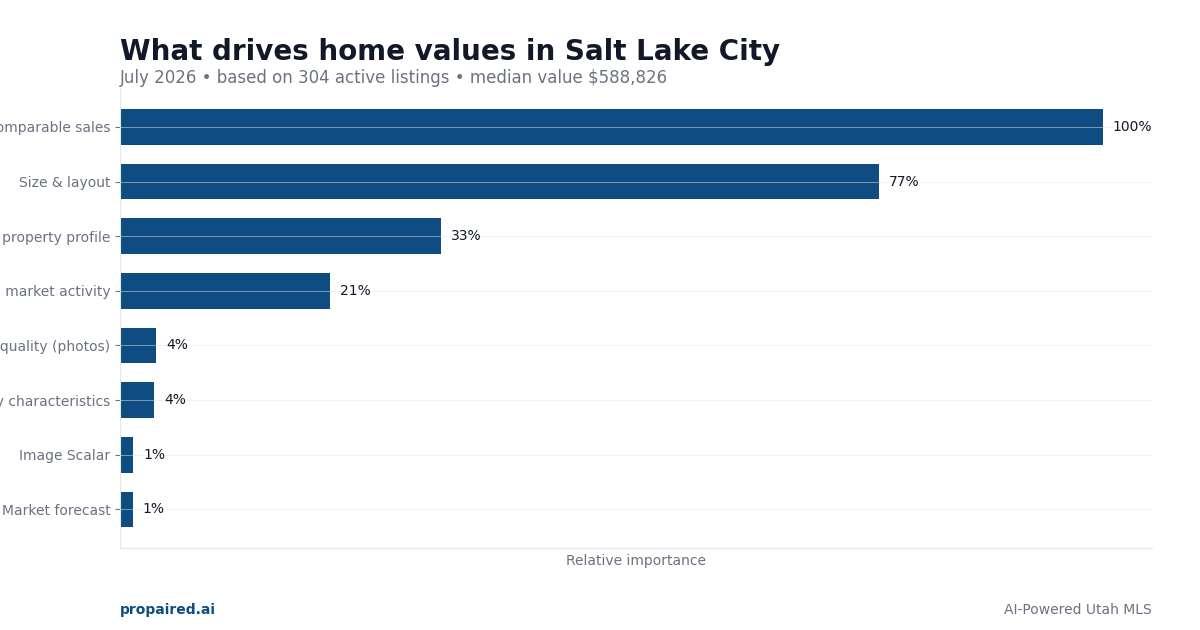
Top themes our automated valuation considers when pricing homes in Salt Lake City.
The Current Salt Lake City Market Landscape
Salt Lake City's housing market continues to show resilience despite broader economic headwinds. Modern & Main Real Estate recently reported that the city's median sale price increased by nearly 10% year-over-year in April 2026, demonstrating the market's underlying strength.
Our analysis of 304 active listings reveals a market where the median living area is 2,340 square feet, with values ranging from $460,881 at the 25th percentile to $825,210 at the 75th percentile. This wide range reflects the diverse housing stock across Salt Lake City's varied neighborhoods, from historic avenues properties to newer developments in the valley.
However, recent mortgage rate increases have added complexity to the market dynamics. Deseret News noted that rates rose sharply to 6.51% for a 30-year fixed mortgage, partly attributed to geopolitical tensions. This rate environment is influencing both buyer behavior and pricing strategies across the metro.
What Actually Determines Home Values: The Data Behind the Numbers
Our automated valuation system reveals that comparable sales carry the heaviest weight in determining Salt Lake City home values, accounting for approximately 38% of our valuation decisions. But here's where it gets interesting—comparable sales data shows both the largest positive and negative influences on pricing, with a total impact weight exceeding 30 million across our dataset.
Size & layout emerges as the second most critical factor, with nearly 24 million in total weight influence. This makes sense in a market where living space commands premium pricing, especially given Salt Lake City's geographic constraints and development patterns.
Overall property profile rounds out the top three, encompassing the holistic view of a property's condition, age, and general appeal. Together, these three factors account for the majority of valuation decisions in our market-trend model.
The Comparable Sales Reality
In Salt Lake City's tight inventory environment, comparable sales data can work both for and against sellers. Properties that align well with recent high-performing sales benefit significantly, while those that fall short of neighborhood benchmarks face headwinds. Our comparable-sales engine processes thousands of recent transactions to identify the most relevant pricing signals for each property.
Why Size & Layout Matter More Than Ever
With the median home approaching 2,340 square feet, size & layout optimization has become crucial. Properties that maximize usable space, offer flexible floor plans, and present well-proportioned rooms consistently outperform those with awkward layouts or inefficient use of square footage.
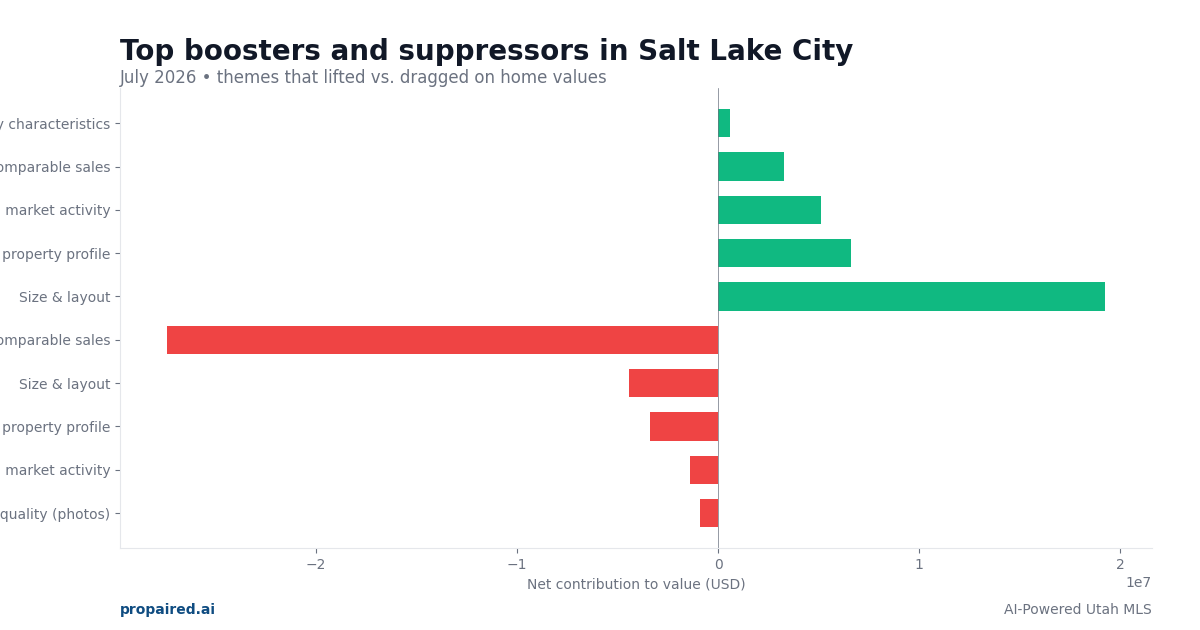
Where Salt Lake City sellers can lift their value vs where the market is dragging on it.
Market Forces Shaping Salt Lake City Home Values
Neighborhood market activity plays a significant role in Salt Lake City valuations, with our model attributing substantial weight to local market dynamics. Areas experiencing high transaction volumes and price appreciation create positive momentum, while neighborhoods with stagnant activity face valuation challenges.
The Federal Reserve's data on Salt Lake County shows fluctuating median days on market, indicating a market that's neither overheated nor stalled, but rather finding its equilibrium in the current rate environment. This balanced pace allows for more thoughtful pricing strategies rather than the rapid-fire decisions of previous years.
Salt Lake City's Planning Commission is also reviewing the Expanding Housing Options (EHO) proposal, which would allow smaller homes in single-family zones. Building Salt Lake reported on these zoning changes, which could impact future supply dynamics and influence long-term value trajectories across different property types.
Visual Quality's Surprising Impact
While visual quality from listing photos ranks lower in our overall model, it still influences buyer perception and time on market. Properties with poor photography or presentation often struggle to achieve their full valuation potential, even when fundamentals are strong.
Strategic Insights for Salt Lake City Sellers
Given that property fundamentals dominate this market, sellers should focus on maximizing their home's inherent characteristics rather than expecting dramatic returns from cosmetic improvements. Our analysis shows zero average achievable seller uplift when top suggestions are addressed, indicating that the market efficiently prices properties based on their core attributes.
The most impactful seller actions center on presentation and maintenance rather than major renovations. Repairs, cleaning, and maintenance (typically $2,000–$12,000) address deferred maintenance that could negatively impact valuation. Kitchen and bathroom refreshes ($300–$8,000 and $300–$4,000 respectively) focus on presentation improvements that help properties compete within their natural price bands.
Professional staging and photography ($1,500–$4,000) can help properties present closer to their optimal valuation, particularly important in a market where visual quality influences buyer engagement and time on market.
The ROI Reality Check
Unlike markets where cosmetic improvements can drive significant price premiums, Salt Lake City's data-driven buyers and efficient comparable sales information mean that improvements typically help properties achieve their fair market value rather than exceed it. Focus on eliminating negatives rather than trying to create artificial positives.
Timing and Market Context
With price increase counts showing month-over-month growth according to Federal Reserve data, timing remains important. Properties that come to market well-prepared can capitalize on positive momentum, while those requiring significant work may face extended marketing periods in the current rate environment.
Home values in Salt Lake City Utah are driven by fundamental property characteristics and market dynamics rather than cosmetic enhancements. With our automated valuation system showing that comparable sales, size & layout, and overall property profile dominate pricing decisions, successful sellers focus on presenting their home's inherent strengths rather than trying to manufacture value through improvements.
In a market where the median home value sits at $588,826 and recent data shows continued price appreciation, understanding these valuation drivers becomes crucial for both sellers and their agents. The key is working with the market's data-driven reality rather than against it—ensuring your property competes effectively within its natural price band while avoiding over-improvement in a market that efficiently prices based on fundamentals.
For the most current valuation insights and market analysis, explore Propaired's AI-powered tools that help Utah homeowners and agents make informed decisions in this dynamic market.
What's selling in Salt Lake City right now
Related news
Comments
Sign in to leave a comment.
