Salt Lake City Home Values 2026: What Drives Prices & Seller Strategies
Understanding Home Values in Salt Lake City: What Really Drives Prices in 2026
If you're thinking about selling your home in Salt Lake City, here's the reality: property fundamentals dominate value in this market, and there's not much room for sellers to lift price through cosmetic improvements alone. With a median home value of $540,264 across our metro and active inventory sitting at 2,881 listings, understanding what actually moves the needle on pricing has never been more critical. Our automated valuation system processes thousands of data points daily, and the patterns are clear—success comes from understanding how comparable sales, size and layout, and neighborhood dynamics work together to determine your home's worth.
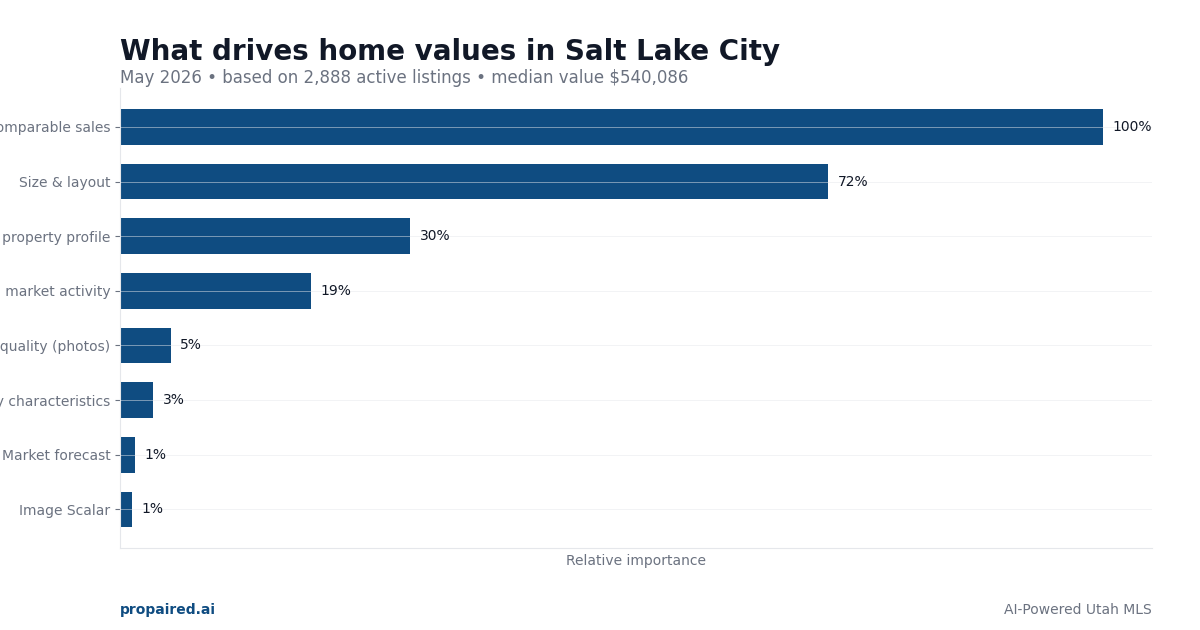
Top themes our automated valuation considers when pricing homes in Salt Lake City.
The Salt Lake City Market Landscape in 2026
Salt Lake City's housing market continues to reflect the broader Utah growth story, but with some notable shifts in 2026. The median list price has reached $569,900, sitting above our automated valuation median of $540,264—a gap that tells us sellers are testing the market's appetite for premium pricing.
With 2,218 square feet as the median living area and values ranging from $430,527 at the 25th percentile to $759,363 at the 75th percentile, we're seeing significant variation based on property characteristics and location. AOL reported in February that market timing has become increasingly important, with the balance of buyers and sellers creating varying conditions across different neighborhoods.
The Northwest Salt Lake Valley presents particularly interesting dynamics. According to a recent Utah Policy analysis, this area is experiencing rapid expansion while maintaining relative affordability compared to central Salt Lake City. Meanwhile, Salt Lake City's recent allocation of $8.1 million toward nearly 600 affordable housing units signals ongoing supply-side pressures that could influence pricing patterns.
What Actually Drives Home Values: The Data Behind the Numbers
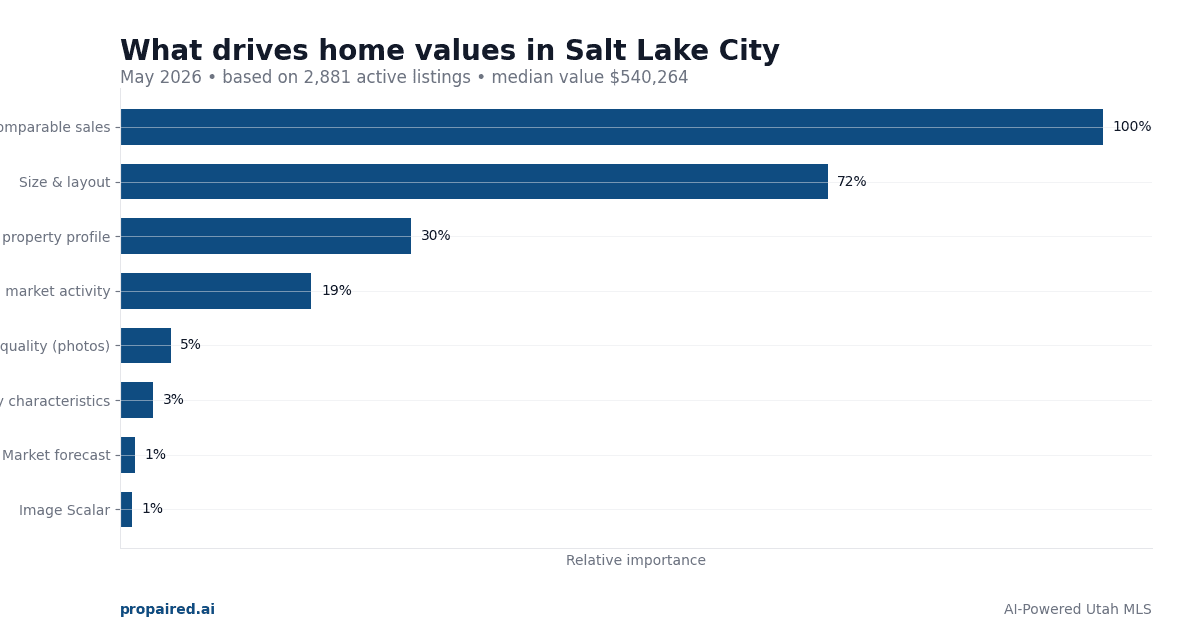
Our market-trend model reveals that comparable sales carry the heaviest weight in determining home values, accounting for roughly 36% of valuation decisions on average. But here's what's fascinating: comparable sales data shows both the strongest positive and negative influences on pricing, with a total impact weight of nearly 292 million across our current inventory.
Size and layout emerges as the second most influential factor, with over 210 million in total weight. This makes sense in a market where the median home sits at 2,218 square feet—properties that optimize their square footage and flow command premiums, while those with awkward layouts or inefficient use of space face headwinds.
Overall property profile rounds out the top three drivers, encompassing everything from architectural style to lot characteristics. What's telling is that neighborhood market activity also plays a significant role, reflecting how local micro-markets within Salt Lake City can create their own pricing dynamics.
The Comparable Sales Engine
Our comparable-sales engine doesn't just look at recent sales—it weighs factors like days on market, final sale price versus list price, and seasonal adjustments. In Salt Lake City's current environment, properties that align well with recent comparable sales see positive lift, while those that deviate significantly face pricing pressure.
Property Characteristics That Matter Most
Beyond square footage, our automated valuation identifies specific characteristics that consistently influence pricing: lot size and usability, garage capacity, basement finish quality, and architectural cohesion with the neighborhood. These fundamentals can't be easily changed, which is why understanding your property's natural position in the market is crucial.
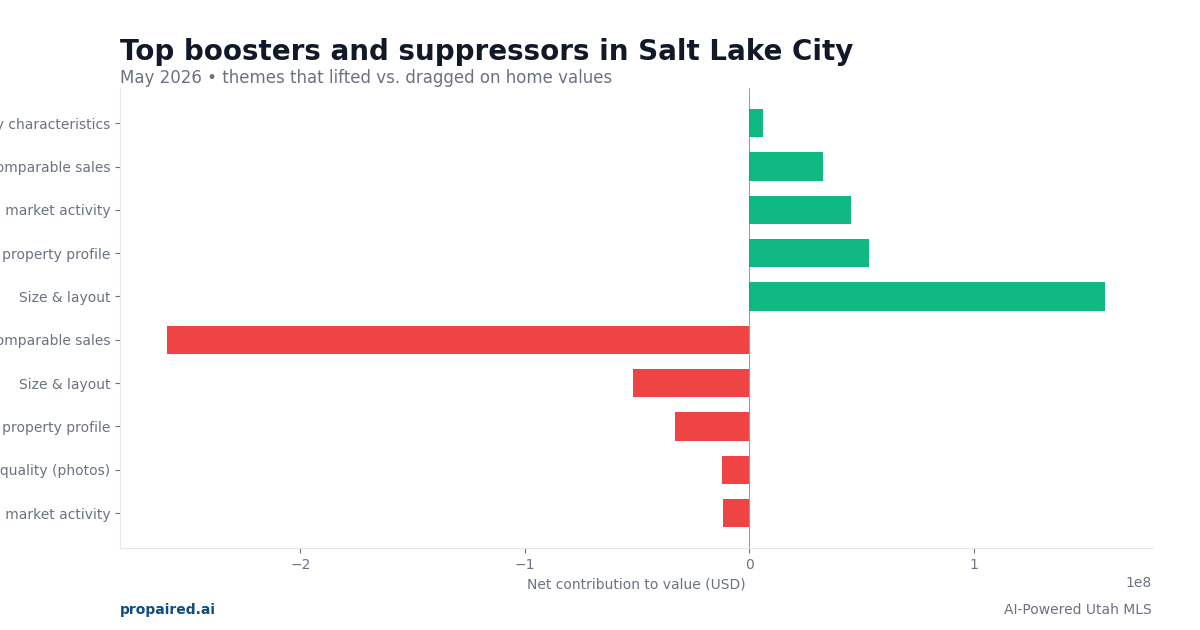
Where Salt Lake City sellers can lift their value vs where the market is dragging on it.
Market Pressures: What's Lifting and Suppressing Values
The same factors that drive values can also suppress them, and Salt Lake City's market shows this dual nature clearly. Comparable sales top both our positive and negative influence lists, meaning that while strong comps can lift your value, weak nearby sales can drag it down significantly.
Size and layout issues create some of the strongest headwinds we see. Properties with choppy floor plans, wasted square footage, or poor flow consistently underperform, even when their total square footage seems competitive. This is particularly relevant in Salt Lake City's diverse housing stock, where mid-century homes might have layouts that feel dated compared to newer construction.
Visual quality from listing photos creates surprising downward pressure on many properties. Our image-based condition scoring reveals that poor photography or properties that photograph poorly due to lighting, staging, or maintenance issues face measurable pricing penalties. With buyers increasingly making initial decisions based on online listings, this factor has grown in importance.
Interestingly, neighborhood market activity can work both ways. Areas seeing new development—like the proposed 16-story mixed-use tower in Sugar House—may experience both uplift from increased desirability and pressure from additional supply.
Strategic Actions for Salt Lake City Sellers
Given that property fundamentals dominate this market, successful sellers focus on maximizing their existing assets rather than trying to transform their property's basic appeal. Our analytics team has identified specific actions that consistently deliver results, with average achievable uplift of $86 when top suggestions are properly addressed.
Kitchen and bathroom refreshes lead our recommendations, but not because they add square footage—because they help properties photograph and show at their price point. A $300-$8,000 kitchen refresh focusing on hardware, lighting, and counters often delivers strong ROI by helping the property compete effectively with comparable sales.
Professional staging and photography has become essential, with typical investments of $1,500-$4,000 helping properties read closer to their intended price band. This is particularly important given how visual quality impacts our automated valuations.
Maintenance and presentation work—from $2,000-$12,000 in deferred maintenance to $300-$3,000 in curb appeal improvements—helps properties avoid the negative comparable sales pressure that drags down values.
Timing Your Market Entry
Utah's first-time home-buying assistance program, as recently analyzed in local media, continues to drive demand from qualified buyers. Understanding these demand cycles and timing your listing to capture motivated buyer segments can influence both speed of sale and final price.
Leveraging Unique Features
If your property has a pool, scenic views, or finished basement space, proper photography and presentation of these features costs little ($0-$300) but can significantly impact how your home compares to similar properties. Our valuation model specifically accounts for these differentiators when they're properly showcased.
Salt Lake City's housing market in 2026 rewards sellers who understand the fundamentals: comparable sales drive pricing decisions, property characteristics matter more than cosmetic improvements, and professional presentation helps properties compete at their natural price point. With median values at $540,264 and significant variation across neighborhoods, success comes from positioning your property effectively within its comparable sales universe rather than trying to transcend it through improvements alone.
The key insight from our automated valuation system is that Salt Lake City buyers are sophisticated—they understand value, and they're comparing your property against recent sales with similar characteristics. Focus on helping your home show and photograph at its best, address any maintenance issues that might create negative comparable pressure, and work with professionals who understand how local market dynamics influence pricing.
For sellers ready to navigate this market strategically, the opportunities are real. But they require understanding what actually moves values in Salt Lake City—and what doesn't.
What's selling in Salt Lake City right now
Related news
Comments
Sign in to leave a comment.
