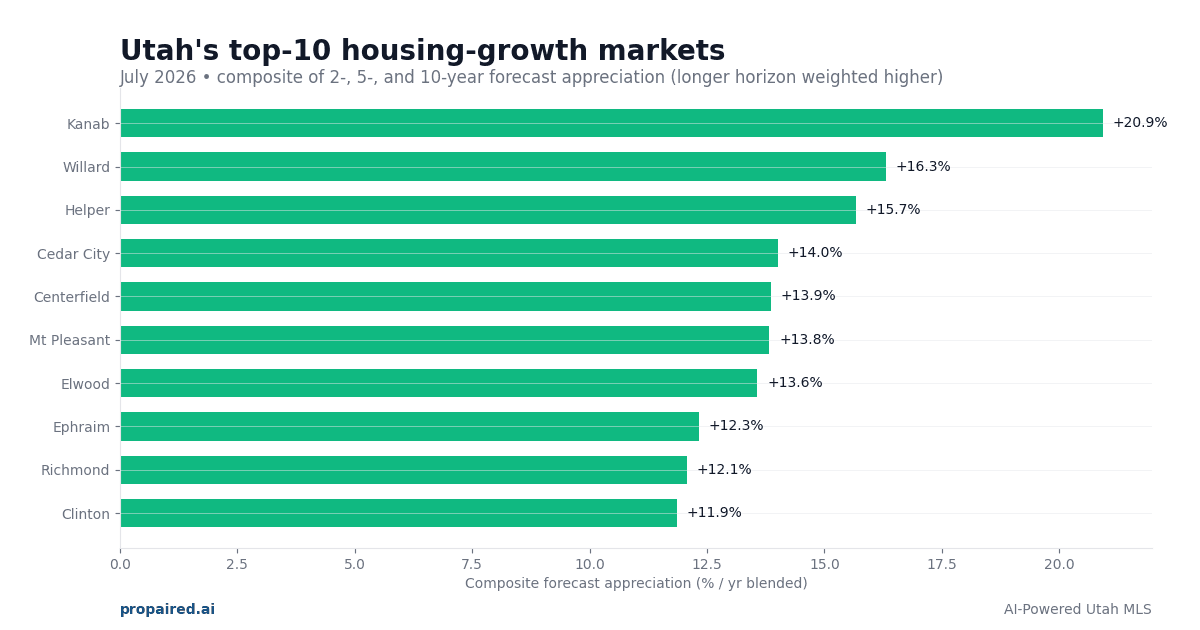
Utah Real Estate Forecast 2026: Top 10 Growth Markets for Long-Term Investors
Utah Real Estate Forecast 2026: Top 10 Growth Markets for Long-Term Investors
Utah's housing market continues to demonstrate resilience and growth potential as we move through 2026, though the landscape has evolved considerably from the explosive gains of recent years. Our long-horizon market model expects statewide median appreciation of +16.06% annually over the next two years, moderating to +5.69% annually through 2031 and +3.38% annually through 2036. While these figures represent a normalization from peak pandemic-era growth, they still position Utah as one of the nation's more attractive long-term real estate markets.
For investors and homeowners considering extended holding periods, the key insight lies not in statewide averages but in identifying specific markets where demographic shifts, infrastructure development, and economic diversification create sustained appreciation potential. Our forecast engine analyzed 111 Utah cities to identify those with the strongest composite growth outlook, weighting long-term sustainability over short-term volatility.
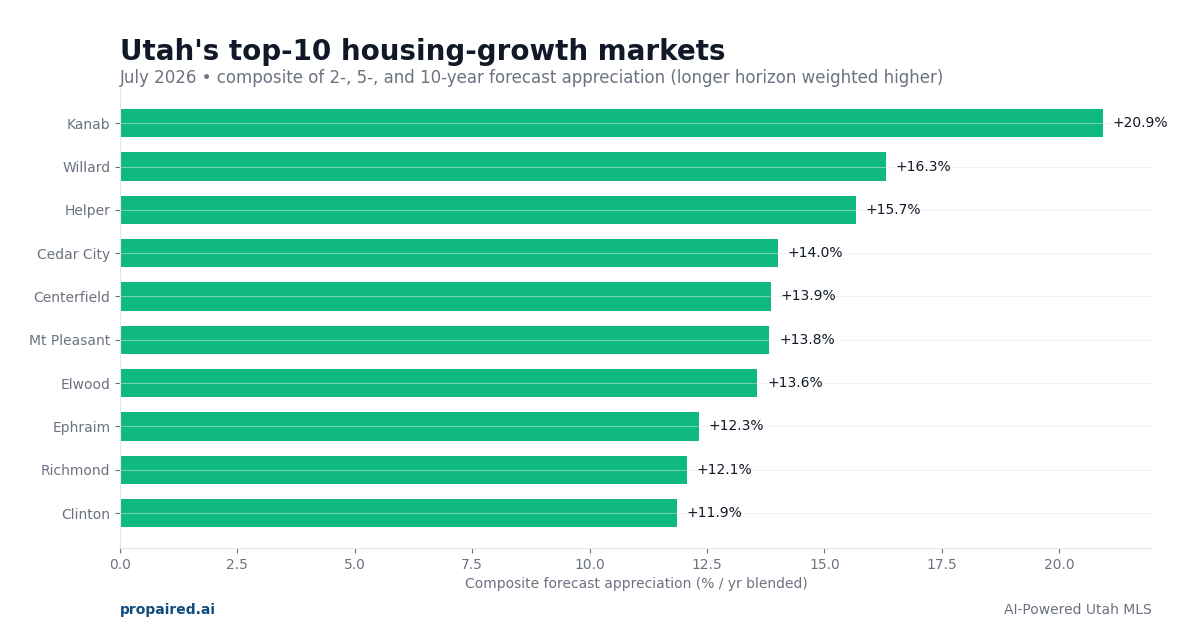
Composite blend of 2-, 5-, and 10-year forecast appreciation.
Market Methodology and Forecast Framework
Propaired's price-trajectory model employs a composite scoring system that balances near-term momentum with long-horizon sustainability. The methodology assigns 20% weight to 2-year CAGRs, 30% to 5-year projections, and 50% to 10-year forecasts — deliberately emphasizing extended holding periods over speculative short-term gains.
This weighting reflects our view that sustainable real estate appreciation stems from fundamental economic drivers rather than cyclical market conditions. Cities that score highest in our composite rankings typically demonstrate strong population growth trajectories, diversified employment bases, and infrastructure investments that support long-term housing demand.
The model's forward view incorporates demographic trends, employment diversification, housing supply constraints, and regional connectivity factors. Importantly, these are forecasts based on current data patterns — not guarantees of future performance.
Top 10 Utah Growth Markets: Complete Rankings
The following table presents our complete top-10 rankings for July 2026, showing expected compound annual growth rates across all forecast horizons:
| Rank | City | 2yr CAGR | 5yr CAGR | 10yr CAGR | Composite Score |
|---|---|---|---|---|---|
| 1 | Kanab | +50.40% | +16.19% | +11.98% | +20.93 |
| 2 | Willard | +50.59% | +11.09% | +5.71% | +16.30 |
| 3 | Helper | +32.69% | +16.88% | +8.12% | +15.66 |
| 4 | Cedar City | +31.22% | +9.59% | +9.77% | +14.01 |
| 5 | Centerfield | +35.29% | +15.73% | +4.17% | +13.86 |
| 6 | Mt Pleasant | +34.62% | +15.97% | +4.22% | +13.82 |
| 7 | Elwood | +39.74% | +8.31% | +6.26% | +13.57 |
| 8 | Ephraim | +30.24% | +13.38% | +4.54% | +12.33 |
| 9 | Richmond | +37.61% | +9.40% | +3.46% | +12.07 |
| 10 | Clinton | +41.37% | +7.63% | +2.58% | +11.85 |
These rankings reveal a clear pattern: markets with the strongest composite scores balance robust near-term appreciation potential with sustained long-horizon growth. The model expects significant outperformance relative to statewide medians across all time horizons.
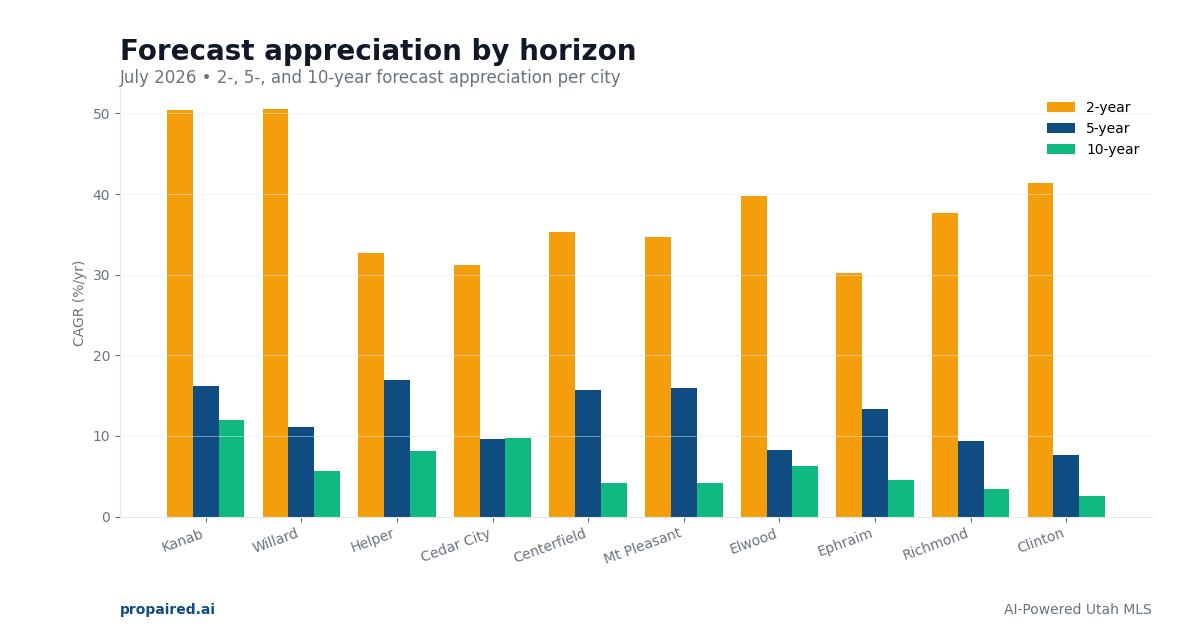
Side-by-side 2-, 5-, and 10-year CAGR for each top-10 market.
Deep Dive: Top 5 Market Profiles
Understanding the drivers behind our highest-ranked markets provides insight into the structural factors our model weighs most heavily in long-term appreciation forecasts.
Kanab: Tourism Gateway with Infrastructure Momentum
Kanab claims the top position with a composite score of +20.93, driven by exceptional long-term appreciation potential of +11.98% annually through 2036. The model's forward view reflects Kanab's unique position as a gateway to multiple national parks, combined with ongoing infrastructure improvements that support both tourism and residential development.
The city's 2-year forecast of +50.40% annually suggests significant near-term momentum, while the sustained 10-year outlook indicates structural demand drivers beyond cyclical tourism patterns. Limited housing supply relative to growing demand from both seasonal residents and tourism-industry workers creates a favorable supply-demand dynamic.
Willard: Northern Utah's Emerging Corridor
Willard ranks second with a +16.30 composite score, benefiting from its position in Box Elder County's growing residential corridor. The model expects +50.59% annual appreciation over two years, moderating to +5.71% through the 10-year horizon.
Willard's appeal stems from its proximity to both Ogden employment centers and recreational amenities, while maintaining lower housing costs than established Wasatch Front markets. The forecast reflects expected spillover demand as buyers seek affordability within commuting distance of major employment hubs.
Helper: Carbon County's Diversification Story
Helper secures third place with a +15.66 composite score, representing one of Utah's most compelling economic diversification narratives. Our forecast engine expects +32.69% annual growth over two years, accelerating to +16.88% through the 5-year horizon before moderating to +8.12% long-term.
The city's transformation from coal-dependent economy to outdoor recreation and remote-work destination creates multiple demand drivers. Helper's affordability relative to Park City and Moab, combined with improved connectivity, positions it for sustained appreciation as Utah's recreation economy expands.
Cedar City: Southern Utah's Education and Healthcare Hub
Cedar City ranks fourth with a +14.01 composite score, reflecting its role as southern Utah's primary education and healthcare center. The model expects +31.22% annual appreciation over two years, with particularly strong 10-year potential at +9.77% annually.
Southern Utah University's presence provides employment stability, while Cedar City's position as a regional medical hub creates sustained housing demand. The forecast incorporates expected population growth as retirees and remote workers discover the area's combination of amenities and affordability.
Centerfield: Rural Growth in Central Utah
Centerfield completes the top five with a +13.86 composite score, demonstrating how smaller markets can achieve significant appreciation through targeted growth. Our model expects +35.29% annual growth over two years and +15.73% through five years.
Centerfield's ranking reflects broader trends toward rural and small-town living, accelerated by remote work adoption. The city's agricultural heritage combined with proximity to recreational areas creates appeal for buyers seeking lifestyle changes while maintaining economic connectivity.
Investment Considerations and Risk Factors
While our forecast model identifies significant appreciation potential across Utah's top-ranked markets, investors should consider several key risk factors that could impact actual performance.
Market Size and Liquidity: Many top-ranked cities represent relatively small markets where individual transactions can significantly impact median prices. Kanab, Willard, and Helper all have limited housing inventory, which amplifies both upside potential and downside risk.
Economic Concentration Risk: Several markets depend heavily on specific economic drivers. Tourism-dependent cities like Kanab face seasonal volatility and potential disruption from economic downturns or travel pattern changes. Similarly, university towns like Cedar City tie closely to enrollment trends and state education funding.
Infrastructure and Development Capacity: Rapid appreciation forecasts assume adequate infrastructure to support population growth. Water availability, transportation access, and municipal services could constrain development in some markets, potentially limiting actual appreciation relative to model expectations.
Interest Rate Sensitivity: Utah's housing market remains sensitive to mortgage rate fluctuations, particularly in markets where buyers stretch to afford homes. Rising rates could moderate appreciation across all forecast horizons, especially in markets with higher price-to-income ratios.
Strategic Implications for Long-Term Investors
The July 2026 rankings reveal several strategic themes for investors considering Utah real estate with extended holding periods.
Geographic Diversification: Top-performing markets span from southern Utah (Kanab, Cedar City) to northern corridors (Willard, Richmond) and central regions (Helper, Centerfield). This geographic spread suggests statewide demographic and economic trends rather than localized phenomena.
Size and Scale Considerations: Investors should carefully evaluate market size relative to investment goals. Smaller markets offer higher appreciation potential but require longer holding periods to achieve liquidity. Larger investors may find insufficient inventory in top-ranked markets to deploy significant capital.
Timeline Alignment: The composite scoring methodology favors markets with sustained long-term potential over short-term speculation. Investors with 10+ year horizons may find better risk-adjusted returns in markets like Kanab and Cedar City that show consistent appreciation across all forecast periods.
Due Diligence Requirements: High-growth forecasts in smaller markets require enhanced due diligence around local economic drivers, development pipelines, and regulatory environments. Investors should verify that fundamental growth drivers align with model assumptions before committing capital.
Utah's housing market enters the second half of 2026 with a compelling long-term outlook, though the era of universal double-digit appreciation has clearly ended. Our forecast model identifies significant opportunities in markets where demographic shifts, economic diversification, and infrastructure development create sustained demand drivers.
Kanab's exceptional composite score of +20.93 reflects its unique position at the intersection of tourism growth and residential development, while markets like Helper and Cedar City demonstrate how economic diversification can drive sustained appreciation. For investors with appropriate risk tolerance and extended time horizons, these markets offer compelling alternatives to Utah's established metropolitan areas.
The key insight for 2026 and beyond lies in selectivity. While statewide appreciation expectations remain positive, the highest returns will likely concentrate in markets with specific competitive advantages — whether geographic, economic, or demographic. Investors who align their strategies with these fundamental drivers, while carefully managing the inherent risks of smaller markets, may find Utah's evolving housing landscape offers attractive long-term opportunities.
As always, these forecasts represent our model's forward view based on current data patterns, not guarantees of future performance. Successful real estate investment requires combining quantitative analysis with local market knowledge and appropriate risk management strategies.
Utah market context
Comments
Sign in to leave a comment.
