Utah Real Estate Forecast 2026: Top 10 Housing Growth Markets for Investors
Utah's Top 10 Housing Growth Markets: May 2026 Investor Outlook
Utah's housing market continues to demonstrate remarkable resilience, with our long-horizon market model projecting statewide median appreciation of 14.44% annually over the next two years, 16.57% over five years, and 3.11% over the decade. While these figures reflect a market in transition—strong near-term momentum balanced by more measured long-term expectations—the geographic distribution of opportunity remains highly concentrated. Our analysis of 110 Utah cities reveals a clear hierarchy of growth potential, with smaller markets leading the charge and established metros showing more tempered trajectories. For investors seeking alpha in Utah's evolving landscape, understanding these micro-market dynamics has never been more critical.
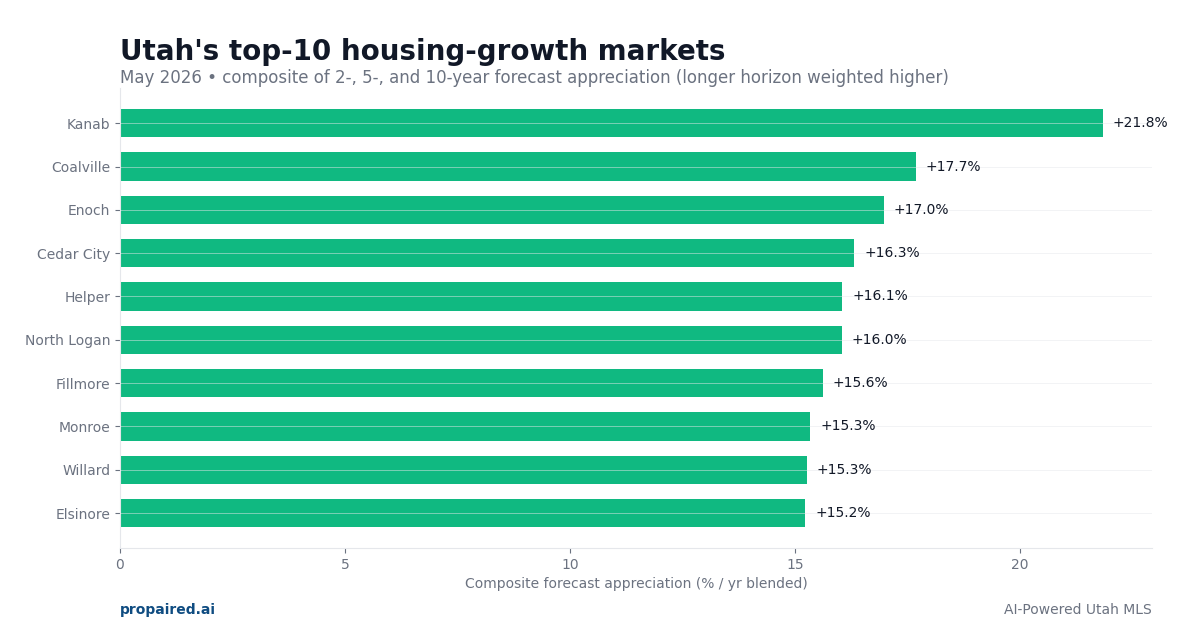
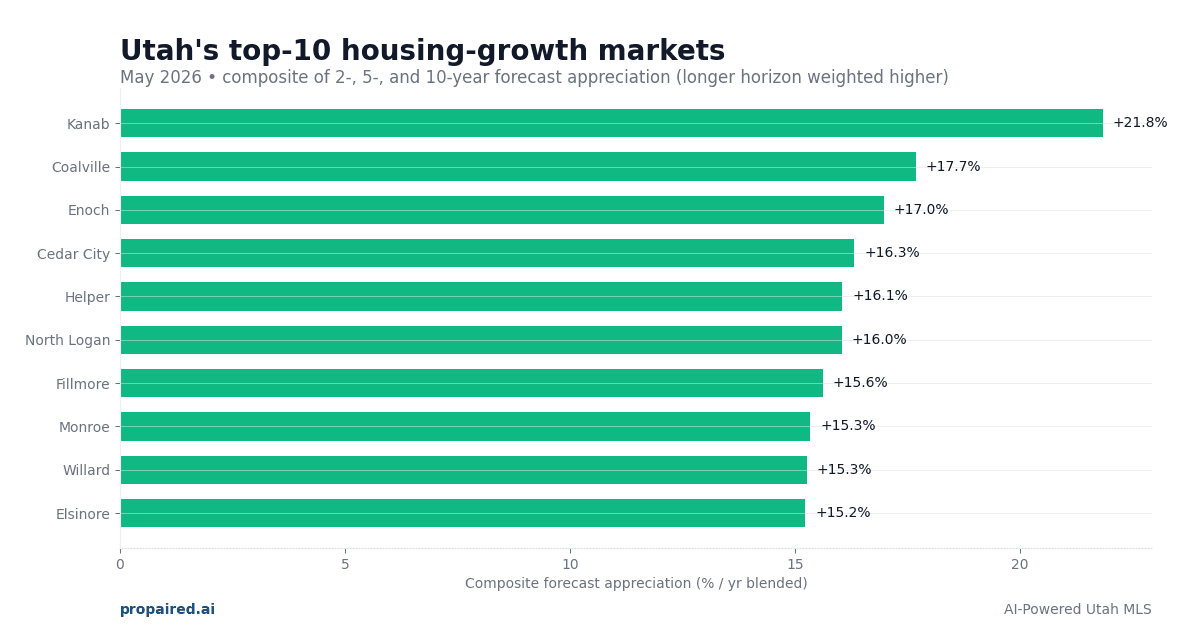
Composite blend of 2-, 5-, and 10-year forecast appreciation.
Market Context: Navigating Utah's Growth Transition
Utah's housing market finds itself at a fascinating inflection point in May 2026. The statewide forecast pattern—robust near-term appreciation tapering to more sustainable long-term growth—reflects broader economic realities that savvy investors must understand.
The current environment presents both opportunity and complexity.
Mortgage rates remain near three-year lows, creating favorable financing conditions for qualified investors. However,
questions persist about demand sustainability as rates show signs of upward pressure. This dynamic creates a window of opportunity for investors who can act decisively while financing remains accessible.
Our forecast engine weights long-term sustainability heavily (50% of the composite score derives from 10-year projections), reflecting the reality that today's hottest markets may not sustain their momentum indefinitely.
Despite mortgage rates reaching yearly highs, housing demand has held up remarkably well, suggesting underlying market strength that transcends short-term rate fluctuations.
The geographic concentration of growth opportunities is striking. While Utah's major metros continue to attract attention, our model identifies smaller markets as the primary drivers of appreciation over the forecast horizon. This shift reflects infrastructure development, demographic migration patterns, and the relative affordability that smaller markets still offer compared to established urban centers.
Top 10 Growth Markets: The Complete Rankings
Our long-horizon market model has analyzed 110 Utah cities to identify the markets with the strongest appreciation potential through 2036. The composite scoring methodology weights long-term sustainability heavily, with 50% of the score derived from 10-year projections, 30% from five-year forecasts, and 20% from two-year expectations.
| Rank | City | 2yr CAGR | 5yr CAGR | 10yr CAGR | Composite Score |
|---|---|---|---|---|---|
| 1 | Kanab | +43.53% | +27.65% | +9.69% | +21.85 |
| 2 | Coalville | +20.74% | +37.95% | +4.33% | +17.70 |
| 3 | Enoch | +19.93% | +26.27% | +10.23% | +16.98 |
| 4 | Cedar City | +20.50% | +25.63% | +9.07% | +16.32 |
| 5 | Helper | +37.54% | +18.03% | +6.28% | +16.06 |
| 6 | North Logan | +19.88% | +33.33% | +4.13% | +16.04 |
| 7 | Fillmore | +29.50% | +28.75% | +2.20% | +15.62 |
| 8 | Monroe | +25.32% | +26.41% | +4.73% | +15.35 |
| 9 | Willard | +17.92% | +33.17% | +3.46% | +15.27 |
| 10 | Elsinore | +24.26% | +25.46% | +5.49% | +15.24 |
The data reveals several key patterns. First, no single market dominates across all time horizons—each top performer has a distinct appreciation profile. Second, the highest composite scores often reflect balanced growth rather than extreme near-term spikes. Third, geographic diversity characterizes the top 10, spanning from southern Utah's tourism corridors to northern agricultural communities.
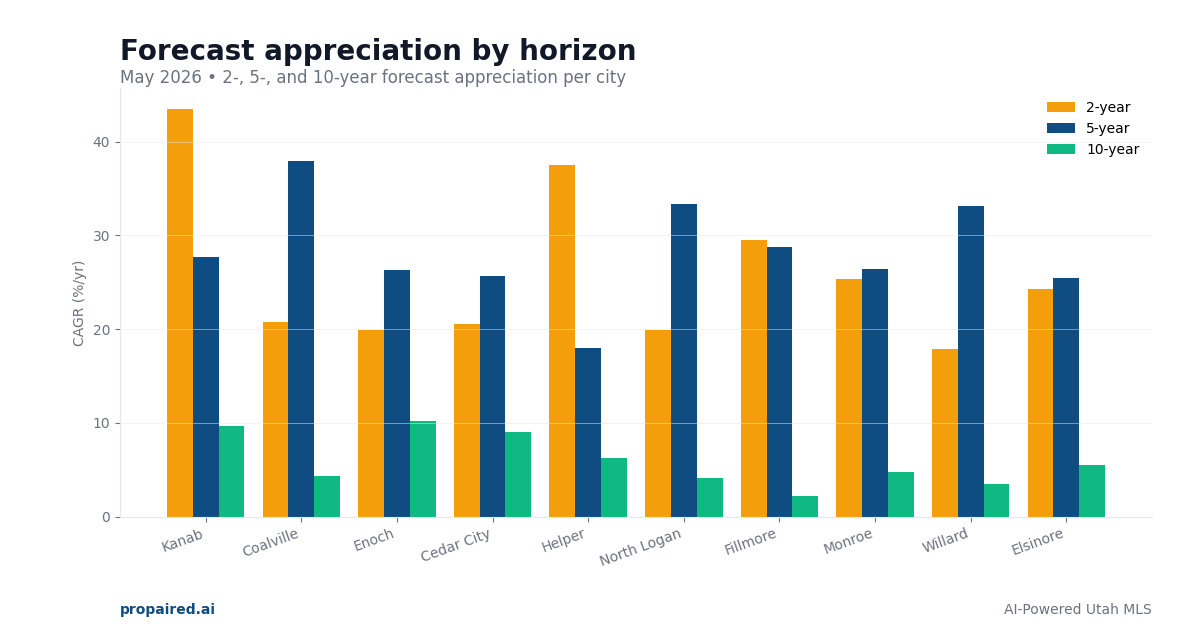
Side-by-side 2-, 5-, and 10-year CAGR for each top-10 market.
Deep Dive: Top 5 Market Analysis
Understanding the drivers behind each top-performing market provides crucial context for investment decisions. Our model's forward view incorporates local economic fundamentals, demographic trends, and infrastructure development patterns that traditional analyses often overlook.
Kanab: The Standout Leader
Kanab claims the top position with a composite score of +21.85, driven by extraordinary near-term momentum (+43.53% annually over two years) that moderates but remains strong over longer horizons. The model expects this southern Utah gateway community to benefit from continued tourism infrastructure investment and its strategic position near major national parks. The +9.69% ten-year CAGR suggests sustainable long-term appreciation despite the dramatic near-term projections.
Coalville: The Balanced Performer
Coalville demonstrates the power of balanced growth, with its +17.70 composite score reflecting exceptional five-year momentum (+37.95% CAGR) supported by steady near-term appreciation. This Summit County community benefits from proximity to Park City while maintaining relative affordability. The model's forecast suggests Coalville represents a sweet spot for investors seeking strong medium-term returns.
Enoch: The Sustained Grower
Enoch stands out for its consistency across time horizons, with the highest 10-year CAGR among the top 5 (+10.23%). This Iron County community near Cedar City benefits from regional economic diversification and population growth. The model expects Enoch to deliver steady, sustainable appreciation that compounds effectively over the full forecast horizon.
Cedar City: The Regional Hub
Cedar City combines regional economic strength with educational institution stability, generating a +16.32 composite score. The model forecasts balanced appreciation across all horizons, with particularly strong 10-year sustainability (+9.07% CAGR). For investors seeking exposure to southern Utah's growth while maintaining diversification, Cedar City represents a compelling anchor market.
Helper: The Turnaround Story
Helper presents the most dramatic near-term trajectory among the top 5, with +37.54% two-year CAGR reflecting the model's expectation of significant economic revitalization. While longer-term projections moderate, the +6.28% ten-year CAGR suggests sustainable transformation. This Carbon County community represents a higher-risk, higher-reward opportunity for investors comfortable with volatility.
Investment Implications and Risk Considerations
The May 2026 forecast environment presents both compelling opportunities and notable risks that investors must carefully weigh.
Most homebuyers expect mortgage rates to fall, but uncertainty about rate trajectories adds complexity to investment timing decisions.
The concentration of growth in smaller markets creates both opportunity and risk. These communities often lack the economic diversification of larger metros, making them more susceptible to single-industry disruptions or demographic shifts. However, they also offer the potential for outsized returns as infrastructure development and population growth create supply-demand imbalances.
March 2026 housing market forecasts noted slight affordability improvements, which could accelerate demand in these emerging markets. The key risk lies in execution—smaller markets often have limited inventory, making it challenging to scale investment strategies effectively.
Liquidity considerations are paramount. While our model expects strong appreciation in these markets, exit strategies may be more complex than in established metros. Investors should plan for longer hold periods and consider the local rental market dynamics when evaluating cash flow potential.
The current rate environment adds another layer of complexity. While financing remains accessible, the potential for rate increases could impact both acquisition costs and exit timing. Investors should stress-test their assumptions against various rate scenarios to ensure strategy resilience.
Utah's housing market in May 2026 presents a compelling but nuanced opportunity landscape. Our long-horizon market model identifies clear winners among the state's 110 analyzed cities, with Kanab, Coalville, and Enoch leading a diverse group of high-potential markets. The statewide forecast—strong near-term momentum transitioning to more sustainable long-term growth—reflects a market finding its equilibrium after years of dramatic appreciation. For investors, the message is clear: opportunity exists, but success requires careful market selection and risk management. The concentration of growth in smaller markets offers the potential for exceptional returns, but demands thorough due diligence and appropriate position sizing. As Utah continues its evolution from a regional to a national economic player, these emerging markets represent the next chapter in the state's real estate story.
Utah market context
Related Utah news
Comments
Sign in to leave a comment.
